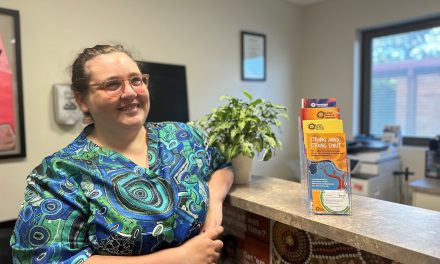
A consultation session. Image: Goondir Health Services
Goondir Health Services is set to play a central role in delivering a new national digital health model that will improve access to healthcare for Aboriginal and Torres Strait Islander people living with chronic disease in rural areas.
Goondir will co-design a strategic framework for a national Indigenous-led digital health service model, in collaboration with The University of Queensland’s Rural Clinical School and the University of Southern Queensland (UniSQ). The project is supported by a $500,000 Medical Research Future Fund (MRFF) grant.
Dr Bushra Nasir from UQ’s Rural Clinical School said a strategic framework would be developed to deliver a national Indigenous-led digital health service model.
“This funding from the National Health and Medical Research Council will help us bridge medical service gaps and improve health outcomes for Indigenous chronic disease patients across Australia,” Dr Nasir said.
During the project’s initial phase, the team developed the Innovative Digital Indigenous Primary Health Care Delivery Model, which integrates virtual health services, point-of-care testing, and digital technologies to strengthen rural healthcare delivery.
“We have undertaken extensive consultation [pictured] and published a study detailing chronic disease challenges and how virtual models of healthcare empower Indigenous communities,” Dr Nasir said.
“Based on our ongoing research, we’re committed to developing a culturally responsive, sustainable and cost-effective model that enables Indigenous Australians with chronic diseases to utilise digital health advances.”
Goondir CEO and co-lead investigator Mr Floyd Leedie said the model provided a holistic approach to tackling chronic disease in a culturally appropriate way that works.
“Patients can use remote monitoring devices in the comfort of their homes, ensuring consistent access to healthcare staff, without the burden of travel or other costs,” Mr Leedie said.
“The national roll-out will be able to provide holistic healthcare to more Indigenous people across Australia.”
Professor Khorshed Alam, a UniSQ health economist and co-lead investigator, will assess the sustainability and cost-effectiveness of the model.
“To ensure long-term success and affordability, it’s important to develop a national framework through consumer and stakeholder collaboration,” Professor Alam said.
“Through rigorous analysis and stakeholder engagement, we will ensure that this digital health model is both scalable and sustainable, fostering community ownership and driving positive health outcomes.”