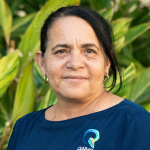
Bo de la Cruz in a quiet moment at Bummiera/Brown Lake in Minjerribah/North Stradbroke Island. Image: QAIHC
Despite national commitments to Closing the Gap as well as national mental health strategies and agreements, mental health outcomes for Queensland’s Aboriginal and Torres Strait Islander peoples remain deeply unequal to non-Indigenous Queenslanders. In some areas, the gap is growing.
Recent findings from the Productivity Commission’s Mental Health and Suicide Prevention Agreement Review interim report found the Agreement was “not working as intended” and that current arrangements were too focused on jurisdictions and funding flows rather than on delivering better outcomes for people.
The Productivity Commission has called for urgent reform, stronger First Nations leadership, and a shift toward more coordinated, person-centred care.1 Central to this is a call for a separate schedule to the Agreement to strengthen and support Aboriginal and Torres Strait Islander social and emotional wellbeing (SEWB). The interim report also identifies the contributions of ACCHOs and the SEWB workforce.
“Social and emotional wellbeing is not just an add on, it’s central to how ACCHOs care for our people,” said QAIHC Acting CEO Paula Arnol.
“It’s not just about treating mental illness, it’s about supporting the whole person — spiritually, emotionally, culturally, and socially.
“That means staying strong in our identity, connected to family, culture and Country. This is the heart of the ACCHO model of care. We can no longer have different agencies which oversee our investment under SEWB and comprehensive primary health care.
“With a new term for the Albanese Government, now is the time to stop this disjointed approach, and in line with the report, focus on SEWB and the SEWB workforce as critical priorities.
“But we can’t close the gap without genuine government commitment to supporting the ACCHO Model of Care and growing the resilience and strength of our Mob.
“I support the Productivity Commission’s interim report to draw links to SEWB and a true co-design process. I am also hoping that the revision of the National Strategic Framework for Aboriginal and Torres Strait Islander Peoples’ Mental Health and Social and Emotional Wellbeing brings forward a true funding model to allow the ACCHO sector to get the support to develop their community appropriate service models.”2
But despite these challenges, Indigenous organisations are taking action. Across Queensland, ACCHOs are expanding their Social and Emotional Wellbeing (SEWB) programs, embedding mental health support in culturally safe and community-led ways. These programs often include traditional healing practices, yarning circles, Elders’ involvement, and peer workers.
The demand for these services is high and services are growing in the way they support their community. In 2024, Charleville and Western Areas Aboriginal and Torres Strait Islander Community Health (CWAATSICH) opened a new Healing Centre in Charleville with a fully equipped kitchen for cooking demonstrations, rooms for visiting psychologists, treatment rooms for visiting allied health services, and a bush tucker garden. In 2023, Bidgerdii Community Health Service opened a Wellness Centre in Rockhampton that offers exercise physiology classes, trips to Country and weekly Elder Support groups. In that same year, Goondir Health Services opened a wellbeing centre in St George with a yarning circle, separate men’s and women’s hairdressers and cultural art spaces, as well as trips on Country to strengthen the cultural identity of youth. The new centre also led to improved training and employment opportunities for St George.
“Our sector is committed to coming together, sharing knowledge, and building momentum,” said Tiana Lea, QAIHC Manager, Social Health Programs.
“QAIHC recently hosted a State-Wide Social and Emotional Wellbeing Gathering Yarning to Heal and it was an incredible opportunity for people working in SEWB to share, connect, and strengthen our response to mental health in our communities,” she said.
“The forum provided a space to share what’s working, support each other, and plan for the future together.
“We were honoured to open our event with Professor Pat Dudgeon, who reminded us that our mob have drawn on social and emotional wellbeing for over 60,000 years — a source of strength, resilience and healing that continues to ground us today.”
She said many SEWB workers were managing heavy workloads with limited resources and often don’t have access to the tools, time, or support they need.
If we want to improve outcomes, we need to properly support the people doing this important work every day,” she said.
“This means a clear commitment for the refreshed National Mental Health and Suicide Prevention Agreement Review to include a significant uplift in investment in SEWB which is directed by the community-controlled sector.
“If we’re serious about Closing the Gap, both levels of government need to work in genuine partnership with ACCHOs and critically support the SEWB Framework to change our trajectory of the burden of mental health and the growing incidences of suicides in our community.”
For related information, click through to the latest Data Room.

- Productivity Commission. (2025). National Mental Health and Suicide Prevention Agreement Review – Interim Report [Media release]. https://www.pc.gov.au/inquiries/current/mental-health-review/interim ↩︎
- Commonwealth of Australia. (2017). National Strategic Framework for Aboriginal and Torres Strait Islander Peoples’ Mental Health and Social and Emotional Wellbeing. Department of Prime Minister and Cabinet. ↩︎